
Grossman and Subjective Geometry
Álvaro Medina
Mathematics is, by nature, pure objectivity. Its results do not depend on anyone’s will, mood, or desire. Poetics, by contrast, are subjective and are not governed by the laws of the exact sciences. Because it is closely linked to mathematics, geometry is generally considered objective. A square is a square if its sides are equal—or it simply is not a square. In Joel Grossman’s work, however, it is.
Geometry has long been both a faithful and elusive ally of visual artists. I say elusive because geometric structures do not always reveal themselves clearly, even when they are present, organizing the composition of a painting or sculpture. More than a century ago, when pure abstraction came to the forefront with Kandinsky, Malevich, and Mondrian, geometry became the central protagonist of art. Among historians of the avant-garde, Malevich’s Black Square has come to symbolize the opening of this new chapter.
From that moment onward, the compass, ruler, and set square became as important in the painter’s studio as the pencil and brush, or the chisel and hammer in the sculptor’s workshop. Mondrian famously condemned artists who departed from strict vertical and horizontal lines, rejecting the use of diagonals. Following his example, a language of crisp lines and flat planes of color—free of accidents or visible traces—became dominant. With the force of an almost unbreakable taboo, this canon was embraced with such rigor that minimalism ultimately pursued and achieved the technical perfection of the industrial object, reaching the highest degree of objectivity.
With Grossman, these seemingly sacred principles collapse—deliberately and openly. Within the Latin American context, it is worth recalling the perfectionist rigor that defined the work of artists such as the Argentinians Tomás Maldonado, Lidy Prati, and Julio Le Parc; the Brazilians Luiz Sacilotto and Ivan Serpa; and the Venezuelans Jesús Rafael Soto, Alejandro Otero, and Carlos Cruz-Díez. In their work, geometry is so exacting that imperfection is completely banished.
In Grossman, however, imperfection permeates every detail, freeing the work from the sterile purity that had dominated geometric art for decades. The geometry he employs possesses the authority we admire in those masters, yet it is infused with a distinctly human pulse. His squares are not perfectly precise—yet they remain squares. His cubes may not strictly qualify as cubes, yet the eye accepts them as such.
Both painter and sculptor, Grossman practices these disciplines with a creative drive that allows him to transgress the tradition established by Malevich and deepened by Mondrian. Does Grossman intertwine movements often considered antagonistic—constructivism and expressionism? The answer is yes. And in doing so, he shows that these tendencies can enrich one another.
In the sculptures, paintings, prints, and drawings he presents, the objectivity associated with constructivism emerges in the compositional structure. Cool, calculated, and orderly, the artist organizes elements within space, whether in two or three dimensions. Yet the final surface reveals the warm subjectivity of the expressionist: varied textures, irregular edges, and a tactile finish that individualizes each form. Spontaneity allows him to enter a territory that earlier masters rejected. His exploration therefore merges positions once thought irreconcilable.
Subjective geometry may have no place within the realm of science, but it belongs fully within the domain of poetics. Artists of ancient Egypt endowed it with sacred significance, and Byzantine artists systematized it in mosaics and paintings. Both traditions reveled in the clarity of silhouette and contour.
In Grossman’s work, however, clarity dissolves. Contours vibrate. Straight lines quiver. Measurements yield by millimeters—and sometimes centimeters. Impeccable precision is abandoned, chance is embraced, and passion returns—alive, defiant, and accompanied by a renewed sense of beauty.

Subjective Geometry
Christian Padilla
Although the phrase Subjective Geometry might seem like an oxymoron invented within the art world, it is just as appropriate as the phrase mathematical beauty coined by the world of science. The 1933 Nobel laureate Paul Dirac once remarked that “every physical law must possess mathematical beauty.” For this reason, the world of geometry does not seem entirely foreign to aesthetic interpretation or to a certain subjective and artistic perspective regarding the notion of beauty.
Since time immemorial—long before science organized thought and ideas systematically—the notion of beauty was closely linked to the conception of the gods. Thus even geometry possessed a divine essence, and anyone who dared to question its beauty or perfection risked going against unquestionable precepts. This occurred in more modern times with Johannes Kepler, who was accused of heresy for questioning the divine origin of the heptagon’s form, or when he described the orbits of celestial bodies as ellipses, thereby breaking with the perfection of the circle, which had been believed to be a sacred design. For some religious fundamentalists, casting doubt on divine scientific knowledge had to be rigorously punished so that the foundations of the universe, creation, and divinity would never be questioned as being fully interconnected.
We often fall into the mistake of assuming that the opposite of perfection and order is chaos. This occurs because we tend to confuse chaos with disorder. In fact, chaos is a type of order that cannot be governed by predictability—it is non-linear, and the unexpected prevails. The growth of a tree’s branches, the changing shape of a cloud, or atmospheric weather patterns are manifestations of a geometry that forms according to its own laws. And surprisingly, the scientific effort to understand such manifestations and make them predictable is expressed through the paradoxical term chaotic mathematics, something that could resonate with this new concept of a subjective geometry.
The work of Joel Grossman enters as a perfect example of this attitude, where the unexpected and the non-linear prevail within what at first appears to be a geometric order. His admiration for minimalist art and for pre-Hispanic forms is mediated by a controlled dose of chaos. Both perspectives—the modern and the ancestral—seem to converge in a reminiscence of the constructivism of Joaquín Torres García, an influence that serves as a catalyst allowing Grossman to reconcile mathematics and the divine without fearing the Inquisition.
Yet there is no heresy in Grossman’s work. His geometry, although it questions order in certain ways, does not challenge the divinity hidden within its forms. On the contrary, the gold leaf—an essential component of his work—evokes colonial art and ancestral goldsmith traditions, all those references to how artists have celebrated spirituality and how, through the brilliance of gold, many cultures have approached the creative essence of all things.
I recall a painting by Grossman titled Entropy in Gold, in which the artist included a phrase that reinforces these ideas: “There is some gold in chaos.” Both creation myths and science agree in pointing to chaos as a starting point of the universe. Grossman’s work therefore reflects on origins from both perspectives. Titles of his series such as Multiverses or The Space Between Things reveal his interest in understanding the physics behind creation—a creation that becomes artistic through his interpretation. It is interesting to imagine how his production could easily inspire a cycle of lectures explaining, through art, knowledge as complex as the physics behind the functioning of the universe.
At the same time, gold and mathematics reveal another way in which he pursues origins through the sacred. Grossman finds a strong connection between these two dimensions—the scientific and the religious—through Kabbalah, the teachings that seek to understand the relationship between God and the universe within Judaism. In these teachings, the geometric representation of the Tree of Life becomes a map of creation in which numbers serve as the fundamental tool for understanding God. It is therefore not surprising that Isaac Newton, along with many other physicists, enthusiastically studied Kabbalistic teachings and contributed to humanity’s understanding of universal phenomena through them.
Thus, although we have described the factors that explain Grossman’s subjective imprint on geometry, we might also define his interpretation as a sacred geometry. As with mathematicians, Grossman proposes his own Theory of Creationthrough his work. In this sense, that imagined lecture cycle could even include theologians illustrating, through art, the various ways in which the origin of the universe has been conceived through religion.
In this regard, the arrangement of his works also carries a sacred aura that invites introspection. His monumental paintings, like the canvases of the Rothko Chapel, imbue the space with an atmosphere of contemplation and reflection. His small-format paintings—many of them bearing the luminous imprint of gold leaf—arranged in orderly fashion evoke altars. Some of his sculptures, shaped like columns and titled Totem, reveal a ritual dimension.
Paintings, prints, and drawings of every scale form the universe created by Joel Grossman, where gold and a carefully chosen color palette tie the different series together into a coherent body of work. Yet this extensive production, much like scientific theories about the universe, evolves from the flat and bidimensional (Euclidean geometry) to the three-dimensional (solid or Riemannian geometry). It projects from one dimension into another, extending into space and claiming it.
From paper and canvas, Grossman moves to stone, carving it until it assumes the form of his approximate cube. While the paintings can be understood as archetypes of the sculptures, in the two-dimensional works the central void of the squares is merely the remnant of the outer edge traced by his hand. In the stone cubes, however, it is the interior void that takes the greatest time to create—the inside of the block must be destroyed to generate the nothingness that governs there. Negative space demands the greatest effort, and it is precisely this void that grants beauty to the remaining stone, just as the significance of celestial bodies and their complex laws could not be understood without considering the emptiness in which they are suspended.
These sculptures, penetrable both to touch and to sight, reveal the two faces of the geometry Grossman has placed in dialogue: the subjective geometry evident in the gesture of carving into stone, and the geometric precision present in the smooth interior surfaces painted within.
Technology and ancestry, science and spirituality coexist harmoniously in his work. Lithic totems and ancestral observatories coexist with the James Webb Space Telescope and with space agencies searching for the origin of the cosmos. These numerous questions that preoccupy the artist find expression in his work. In this way, his production becomes his own original and subjective Theory of Creation—a bold and fascinating proposal that, in other times, might have condemned Grossman for heresy before an inquisitorial tribunal.

The Art of Joel Grossman
Eduardo Serrano
Joel Grossman’s work, in addition to being visually attractive, is conceptually intriguing.
Its background of gold leaf suggests that the content of his production is related to physics—and metaphorically to life itself. Upon these golden backgrounds, Grossman draws squares, rectangles, circles, and ellipses: figures that are geometrically precise but that, on his canvases, appear tentative, hesitant, almost uncertain, as if alluding to forms that are only just emerging from primordial chaos.
Symbolically, the work of the alchemists consisted of the transmutation of other elements into gold; yet in reality their goal was to restore to humankind its lost powers—its true spiritual essence.
The imprecise geometry in Grossman’s work faithfully reflects its content, which can be physical and material, or ethereal and spiritual. Balance is one of the attributes of his work: at first glance it may appear unstable, on the verge of falling, yet it remains upright thanks to the conjunction of opposing forces.
Gold and polychromy contrast the symbolic and the festive, the reflective and the worldly.
The viewer is invited to discover the creative process behind each work, to recognize the ideas, feelings, and emotions it contains, and thus to fully experience and enjoy it.

Between – Verses
Alejandra Fonseca
When we observe the works of the artist Joel Grossman, we encounter geometric forms that evoke what is fundamental. The recurring use of figures such as the square and the circle refers to the idea of the origin of the universe, marking the pieces with a sense of time and the concept of space.
The way Grossman treats natural materials reaffirms his intention to bring his works closer to the meaning of what is essential. Gold as a raw material—both background and pigment in many of his paintings and sculptures—seeks to awaken in the viewer a sensation that evokes the sacred, the fiery, the powerful, and the divine. Cotton, present in the papers and canvases of his works, refers to the earthly as the raw material of everything that exists.
In the same way, the presence of the square relates to the four fundamental elements, to the cyclical nature of the four seasons of the year, and to the sacred geometry present in nature that has been adopted by humanity for spaces of spiritual reflection. The sculptures created with cubes of limestone in almost impossible balances recall pre-Hispanic constructions which, inspired by the structures of maize, achieve a timeless beauty and harmony.
Entre-versos brings together works from different series that reflect upon the same ideas: origin, time, and space. Moreover, the reduced use of forms, materials, and colors—each loaded with meaning—constructs a more complex framework that compels the viewer to pause and, with careful attention, “read between the lines,” thereby building a universe of possibilities from their own experiences.
Grossman’s works are not anecdotal; the artist does not intend them to be illustrations of a personal experience. Rather, through his own ritual action in the creation of each piece, he creates symbols—almost emblems—that await interpretation through the mystical and transcendental sense of life. Entre-versos, like a poem of plastic forms, becomes a declaration of love for art.
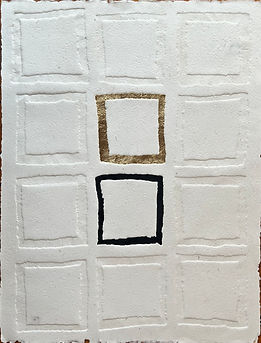
Space Between Things
John Angel
Joel Grossman presents the work Space Between Things. This series of paintings merges the strategies of repetition found in minimalism with the knowledge encoded in the monumental constructions of ancestral civilizations. Joel is interested in the way those artisans and engineers used materials to raise sculptures. From those methods of materialization, he extracts the simplicity of the builders, who manipulated matter in an impeccable way.
His paintings are executed on raw linen and gold leaf, evoking monoliths and totems. The reflection we can draw from this gesture explores the concept of origin and the response to random stimulus.
It raises a fundamental question: in what way will we cooperate together as a civilization to reorganize and redefine our world? Will this happen by learning to recognize the multiplicity of forms of knowledge, so that we may inhabit the world with our senses—now expanded and enhanced through technology?
It is necessary to understand that, as a civilization, we must generate a new symbiosis between human thought and nature, combining ancestral wisdom with new knowledge assisted by molecular technologies and the scientific method of observation.

Pictorial Invisibility, Version Two Minus One: From the Outside In
Jaime Cerón
The horizontal axis of vision, to which the human structure has been strictly subjected in the course of a tearing away of man rejecting his animal nature, is the expression of a misery all the more painful insofar as it appears to be serenity.
— Georges Bataille
The place where visual perception occurs has become, for more than a century, a disturbing space that seems to resemble no known site. Since the analysis of human experience began to consider the physiological aspect of vision, the body appeared as the screen upon which the image of the world is projected. The paradox of these discoveries is that, as artists studied these new theories about the body as the support of vision, they gradually moved away from the habitual description of the visible world in order to see how it is that we see. The historical result of this distancing is what we have known since the twentieth century as abstraction.
Behind the various emblems that have sustained modern and contemporary abstraction lies the strange mark of the body which, according to Georges Bataille, reveals itself in the horizontality of empirical vision that contrasts with the verticality of dominant visuality. Visuality is both the mark of the social construction of the visual and the emblem of the visual construction of the social. Abstraction therefore not only relates to the bodily experience of vision as the matrix of reality, but also reveals how what we see keeps invisible a cultural structure that precedes it.
Joel Grossman has produced a fairly extensive body of paintings and drawings that could be associated with abstraction. These are images that insist on revisiting the visual emblem of concentric structures, present in different moments and places since late modernism. Usually his nests of concentric circles seem to exceed the limits of the canvas, so that the image appears as a fragment of something larger. In other cases these concentric figures are circumscribed—at least in part—within the semi-empty space that surrounds them, suggesting that they are smaller in scale than the support.
This condition is produced by the frontality that characterizes these pieces, which makes them appear more effectively as visual emblems that point toward their own material conditions of production. At first, the relationship between the perceptual experience of the world and the indication of the physical traits of painting may seem strange, yet it has been constant within abstraction precisely because of the way it generates a translation between the body of the viewer and the pictorial object.
In abstraction, visual emblems would be the preexisting cultural structures that fulfill the same function that perspective once did within illusionistic painting. For this reason, the overwhelming experience of the circles reminds us that what a window shows is always smaller than what lies beyond it.